Learn manual design first. Then CAD. That is the order we recommend to almost everyone who asks, and it is the question we are asked most often after "do I need a jewellery background?" (You don't.)
Most people who enquire want to go straight to Rhino or Matrix. It feels faster. The screen looks professional, and the jobs you see advertised mention CAD. We understand the pull. We still ask people to start on paper, and the reason is practical rather than traditional.
What goes wrong when you skip drawing
A designer who has never drawn a setting by hand will build models that look correct on screen and fail at the bench.
Prongs too thin to survive setting. A gallery so tight the polisher cannot pass a thread through it. A shank that cracks where it meets the solder joint. The file goes to the caster, comes back wrong, and nobody can say exactly why.
CAD will let you model all of these. It has no idea what a karigar can actually make. Drawing is where you learn that: how a stone sits, how much metal a claw needs, why a jhumka hangs the way it does.
What manual design actually teaches
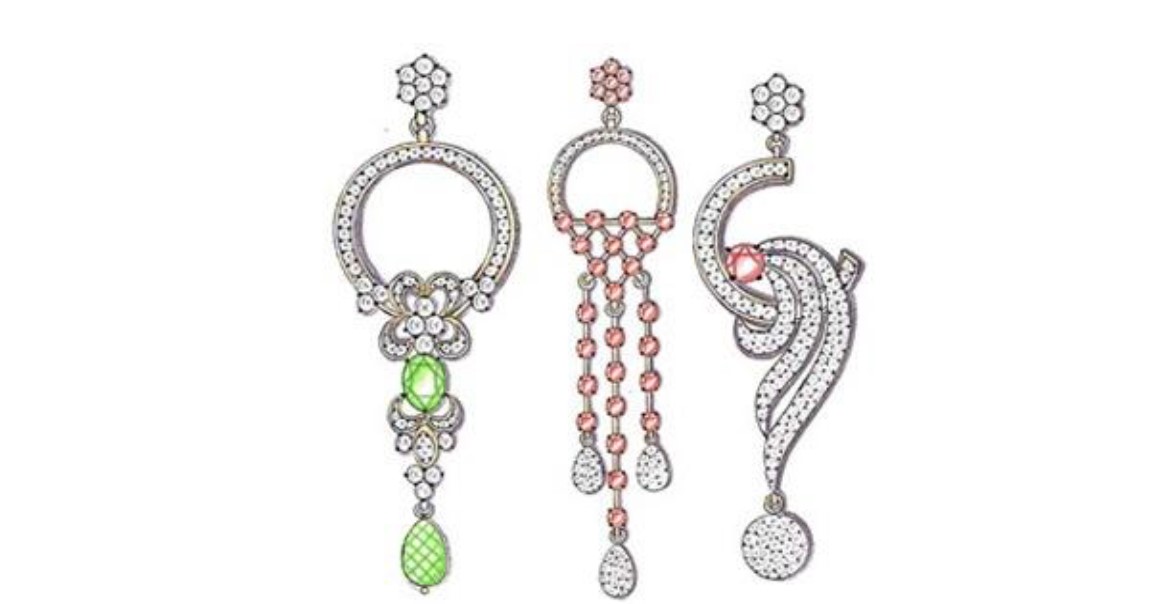
Proportion. Stone facets and how light falls across them. Pencil and colour shading. Gold texture. Then the pieces themselves: rings, jhumkas, chandbalis, kadas, bracelets and polki necklaces.
You also learn to think in settings, which is the part people underestimate. Prong, bezel, channel, pave, flush, cluster, illusion. Each one changes how much metal you need and how the piece is made. Once you have drawn them, you model them properly.
Our Manual Jewellery Designing course runs 3.5 months, live online, with a maximum of 5 students in a batch and recordings you keep. You need paper, pencils and colour pencils. No computer. The fee is ₹12,700 + 18% GST (₹14,986), and it is where every R3 student starts, including our National Jewellery Award winners. The full syllabus is on the manual jewellery designing page.
When CAD comes in
After the basics are in your hands. Usually straight after the manual course.
Rhino first, because Matrix is built on top of it and assumes you know it. ZBrush later, and only if you want organic or sculptural work like temple pieces and animal forms. We explain the differences in our guide to Rhino vs Matrix vs ZBrush, and the beginner's guide to CAD jewellery designing covers what the software actually does.
Someone who has drawn first tends to move through CAD faster, not slower. They already know what they are trying to build.
Is there anyone who should skip manual?
A few. If you have worked at the bench for years, or you already draw jewellery well, talk to us before enrolling. We may suggest going straight to CAD or Procreate. The aim is a designer whose files can be made, not a certificate collection.
Frequently asked questions
Do I need to be good at drawing already?
No. The manual course starts from the beginning, and most students arrive as complete beginners.
Can I do manual and CAD at the same time?
We advise against it. Finish the manual course first, so the CAD classes build on something.
Is manual design still used in the industry?
Yes. Sketches are still how many designs are discussed with clients and karigars, and it is the foundation every CAD model rests on.
How long does the full path take?
Manual is 3.5 months. CAD comes after that, and the timing depends on which software you choose. The courses page lists each one.
Want to start with the right course?
SEE THE MANUAL DESIGN COURSE