Jewellery industry in one of the most elite sectors to make a career.
Now a day, people are more inclined to make career in this industry, due to the evolution of Jewellery industry from visiting store to buying jewelling in mobile app. In the earlier days, hardly anyone would had imagined that your choice of Jewellery would be delivered directly to your doorstep.
The big question is how this happened?
The answer is very simple. With the evolution of technology and skill, like the rest of industry. Now to be in this industry you need to upgrade your skill with the time.
The initial step you need to take: -
First you need to understand designs play a role of a magnet which attracts the client and the same scenario you can observe in almost in any industry.
So, the Jewellery designing is the 1st primary stage, and it is the foundation of any Jewellery after that it goes for 3D CAD software designing which gives the real illusion of a Jewellery without actual production and helps in Jewellery creation with ease.
- To have this skill, first you need to select the proper academy from where you can enhance your knowledge — explore our jewellery designing courses to see the skills you can learn.
- After getting the essential knowledge now you need to work practically where your creativity can be converted into real piece.
- After working practically under any manufacturer or Jeweller, now it’s all up to you whether you want to start you own business or want to continue working under organization.
The most important point if you want to start business but there is some capital issue, so you can start job work on order basis the only thing you need to follow before starting your business is Government legal procedure for more authentication of your business.
For ex: GST, BIS hallmarking license and trade or shop act license.
What skills does a jewellery designer actually need?
A career in jewellery design rests on a mix of artistic and technical skills. On the creative side you need a sense of proportion, form, and detail, and the ability to translate an idea into a clear drawing. On the technical side, most modern studios expect at least a working knowledge of digital tools. The usual progression looks like this:
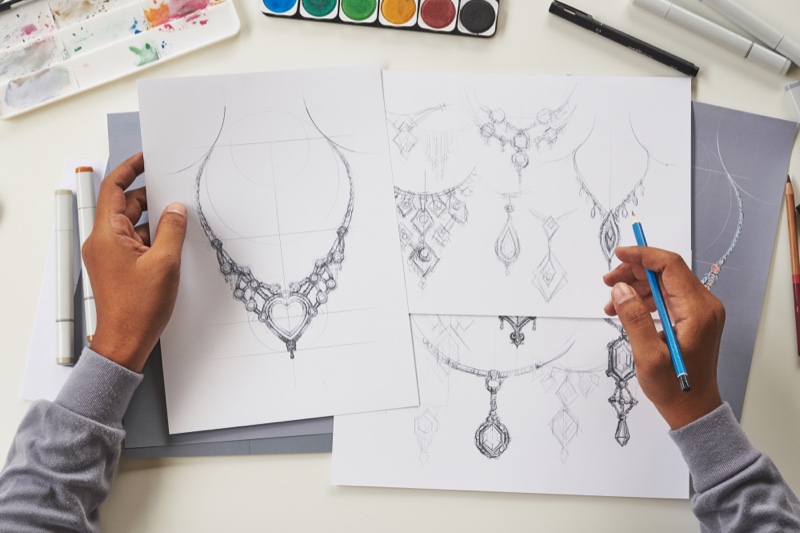
- Manual (hand) designing — the foundation. You learn to sketch and render jewellery by hand: gemstones, metals, settings, and complete pieces. This trains your eye before you ever touch software.
- Jewellery CAD — software such as Rhino or Matrix lets you build precise, production-ready 3D models that can be sent to casting and 3D printing.
- Sculpting and rendering — tools like ZBrush handle organic, highly detailed pieces, while KeyShot and Procreate produce the photorealistic images that sell a design to a client before it is ever made.
- Gemology basics — understanding stones, cuts, and metals helps you design pieces that are beautiful and manufacturable.
What career paths are open to you?
Jewellery designing is not a single job — it opens several routes, and you can move between them as you grow:
- In-house designer at a jewellery brand, manufacturer, or retail house.
- CAD designer / CAD technician, turning concepts into production-ready models.
- Freelance designer or illustrator, taking project work for multiple clients.
- Entrepreneur — launching your own label or a made-to-order design service.
How to get started, step by step
If you are starting from scratch, a practical path is: (1) learn the fundamentals from a structured course and a mentor who reviews your work; (2) practise relentlessly and build a portfolio of your own designs; (3) gain real-world experience through job work, an internship, or a role under an established jeweller; and (4) once you have skills, a portfolio, and industry contacts, decide whether to keep growing within a company or start your own venture. Live, instructor-led online training is a good way to begin because you get direct feedback and can learn from anywhere — explore our jewellery designing courses to see where each skill fits.
What the training actually costs, and how long it takes
Most people asking about this career want two numbers before anything else: the fee and the time. Here is the full picture at R3 Jewel Academy, so you can plan rather than guess.
| Course | Duration | Fee |
|---|---|---|
| Manual Jewellery Designing | 3 months (72 hours) | ₹12,700 + 18% GST |
| Procreate Illustration | 2.5 months (30 hours) | ₹23,500 incl. GST |
| KeyShot Rendering | 2.5 months (30 hours) | ₹23,500 incl. GST |
| ZBrush Sculpting | 3.5 months (42 hours) | ₹31,860 incl. GST |
Manual designing includes a jewellery designing kit worth ₹3,000, because it is the one course where you draw by hand and need the materials. Every course runs the same way: three classes a week, two hours each, a maximum of five students in a batch, and every session recorded and kept for you to rewatch. If a concept does not land the first time, you have the recording and dedicated doubt-clearing time with your mentor.
You do not need all four. Manual on its own is enough to start sketching professionally. Add Procreate when you need to present to clients quickly, and CAD when you need pieces manufactured.
What your portfolio needs before you apply anywhere
A certificate gets read in two seconds. A portfolio is what actually gets you the interview, and most beginners build the wrong one — twenty variations of the same ring, all drawn from photographs.
What a studio wants to see instead:
- Range across categories. Rings, earrings, pendants, bangles and a full necklace set. A designer who has only ever drawn rings is a liability on a bridal brief.
- Traditional Indian work alongside western. If you want to work in India, jhumkas, chandbalis, polki and temple pieces are not optional extras — they are most of the order book.
- Evidence you understand making. Settings that would actually hold a stone, joints that would survive being worn, and a sense of what the piece would cost to produce.
- The reasoning, not just the render. Why that stone, that metal, that proportion. This is the part that separates a designer from someone who can draw.
One route that has actually worked
Suparna Pattanayak Maity enrolled here as a student of manual jewellery designing. In 2025 she won Student of the Year at the National Jewellery Awards. She now teaches the manual designing course at the academy.
We mention her because it is the honest answer to the question worth asking before you pay for any course: has anyone actually got somewhere with it? R3 students have taken the National Jewellery Awards “Student of the Year” title for four consecutive years, 2022 through 2025. That is the same syllabus, the same batch size, the same mentors you would be learning from.
Employment or freelancing — decide early
These two routes need different portfolios, and choosing late costs you months. A manufacturing house or retail studio wants range and production sense: can you draw a full bridal set, and would it survive being made? Freelance clients want a recognisable style and the ability to turn a brief around fast, which is where digital illustration earns its place.
We support both. Students get placement assistance for studio and manufacturing roles, and for those going independent we connect them with jewellery businesses and established freelancers who can supply those first briefs. Your mentor will talk the choice through with you rather than leave it to chance.
If you are in Kolkata, the city itself is an advantage worth using. It has been a jewellery-making centre for generations, with a dense retail and manufacturing trade around hubs like Bowbazar — which means karigars to learn from and buyers to show work to, both within reach.
Frequently Asked Questions
Do I need a fine-arts degree to become a jewellery designer?
No. A formal degree helps, but many working designers start with a focused skills course, a strong
portfolio, and hands-on practice. What matters most is the quality of your designs and your ability
to execute them.
Should I learn manual design or CAD first?
Manual design first. Hand sketching trains your eye for proportion and detail, which makes your CAD
work far stronger. Most professionals learn both.
Can I learn jewellery designing online?
Yes. Live, instructor-led online classes let you learn from a mentor in real time and build a
portfolio from home — the same skills taught in a classroom, with more flexibility.
Ready to start your journey in the glamorous world of jewellery?
ENROLL NOWIn addition to mastering the technical skills like manual sketching and CAD software, remember that building a successful career in the jewellery industry also requires constant learning. Stay updated with the latest trends, attend exhibitions, and continuously refine your portfolio to stand out.