So, you want to be a jewellery designer. Maybe you've always found yourself sketching intricate patterns in the margins of your notebooks, or maybe you just walked past a Tanishq store and thought, "I could design something better than that."
The good news? You absolutely can.
The Indian jewellery market is booming right now. We're seeing a massive shift where traditional, heavy gold designs are making room for sleek, modern, and highly personalized pieces. And the industry is desperate for fresh talent who can bridge the gap between old-school craftsmanship and new-age digital design.
But breaking into this field can feel overwhelming. Do you need a fancy four-year degree? What software should you actually spend time learning? Is manual sketching completely dead?
I'm going to walk you through exactly what it takes to become a professional, highly-paid jewellery designer in India today—no fluff, just the practical steps.
1. What Does a Jewellery Designer Actually Do All Day?
A lot of people think jewellery designers just sit in cafes drawing pretty necklaces all day. The reality is a bit more demanding (and a lot more fun). Today’s designers are part artist, part engineer.
Here is what your actual day-to-day looks like:
- Talking to Clients: You'll spend time figuring out what a client actually wants (even when they don't know it themselves).
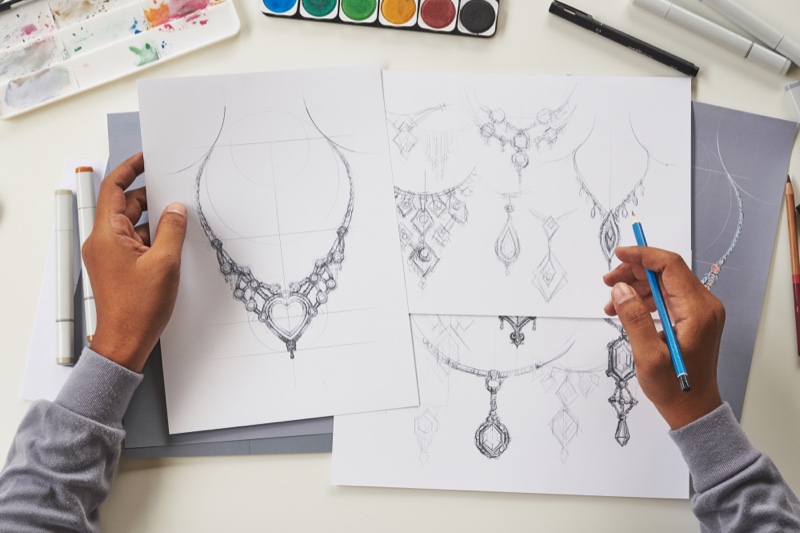
- Manual Drafting: Translating those vague ideas into precise, to-scale drawings on paper.
- 3D Modeling (The Big One): You’ll spend most of your time in front of a computer, using CAD software to build mathematically perfect 3D models of your sketches.
- Troubleshooting: Figuring out why a specific diamond setting won't hold in real life and adjusting the digital model so it actually works when manufactured.
- Working with Karigars: Collaborating closely with the master craftsmen who bring your digital files to life in metal.
2. The Skills You Actually Need (And the Ones You Don't)
You don't need to be a math genius, but you do need a mix of technical chops and creativity.
A. Manual Sketching & Illustration
Let's clear this up right now: you must know how to draw. You don't need to be Picasso, but you need to be able to quickly sketch an idea while sitting across from a client. Manual sketching is your foundation. You need to understand how light hits metal and how to draw facets on a gemstone so it actually looks real on paper.
(Pro tip: A lot of us are swapping paper for iPads these days. Procreate is becoming a massive game-changer for quick, digital sketching).
B. 3D CAD Modeling
If there is one non-negotiable skill on this list, it's CAD (Computer-Aided Design). If you want to get hired by any major brand in India, your CAD skills need to be razor-sharp. CAD is what takes your design from a "nice drawing" to a physical, 3D-printed wax mold that can be cast into gold.
C. Basic Gemology
You can't design a secure ring if you don't understand the stone you're working with. You don't need to be a certified gemologist, but you absolutely need to know the basics. For example, emeralds are brittle and can crack under pressure, whereas diamonds are highly tough. Knowing this changes how you design the prongs holding them.
3. Do You Really Need a Degree? (Degrees vs. Diplomas)
Short answer: No.
If you want to spend four years getting a Bachelor of Design (B.Des), go for it. But the jewellery industry doesn't care about degrees. They care about your portfolio. When you walk into an interview, the hiring manager is going to look at your CAD renders and ask, "Can you actually build this?"
The Fast-Track: Specialized Diplomas
For most people, a focused 3-to-6-month diploma is a much smarter move. Programs like the ones we run at R3 Jewel Academy strip out the filler.
You don't spend months writing essays; you spend hundreds of hours actually building 3D models in Rhino and Matrix. You get in, you learn the exact software the industry uses, you build a killer portfolio, and you get out into the workforce.
4. The Software Stack: What You Must Learn
The software you choose to learn will dictate the kind of jobs you can get. Here is exactly what the Indian market runs on right now:
Rhino (Rhinoceros 3D)
This is the absolute baseline. Rhino is a highly precise 3D modeling tool. If you are designing bangles, structured rings, or geometric pendants, Rhino is where you build the foundation.
Matrix / MatrixGold
Matrix is built on top of Rhino, but it's loaded with tools made specifically for jewellery. Need to place 50 tiny diamonds along a curved ring band? Rhino takes hours to do that manually. Matrix has tools that do it in minutes.
ZBrush
If Rhino is digital engineering, ZBrush is digital clay. You use it for organic, flowing shapes. If you want to design intricate temple jewellery, faces, or floral patterns, ZBrush is the undisputed king.
KeyShot
Nobody wants to look at a grey, boring 3D model. KeyShot is the rendering software that turns your CAD file into a photorealistic image. It makes the gold look shiny and the diamonds sparkle, which is crucial for selling your design to a client before it's even manufactured.
5. What Does the Pay Look Like?
The career landscape is broad, and the money gets very good once you prove you can deliver.
- In-House Brand Designer: Working for the big guys (Kalyan, Reliance, CaratLane). Expect a starting salary somewhere between ₹3,00,000 to ₹5,00,000 a year.
- Freelance CAD Specialist: This is where it gets highly lucrative. Many independent jewelers don't have an in-house CAD designer. If you can model quickly and flawlessly, you can easily pull in ₹6,00,000 to ₹12,00,000+ a year taking on multiple clients.
- Bespoke Designer: Designing custom bridal sets for high-net-worth clients. The margins here are entirely up to your brand value.
6. Building a Portfolio That Actually Gets You Hired
Your portfolio is everything. Do not just throw a bunch of random CAD renders into a PDF. A professional portfolio should tell a story:
- The Inspiration: Show your mood boards. Where did the idea come from?
- The Roughs: Include the messy, initial sketches.
- The Tech Specs: Show orthographic drawings (top, side, front views) with measurements. Prove you understand dimensions.
- The Final Render: The glossy, beautiful KeyShot image of the final piece.
7. A Shameless Plug for R3 Jewel Academy
If you're serious about this, you need to learn from people who actually work in the industry. At R3 Jewel Academy, we've won the National Jewellery Award four times consecutively because our students produce work that is legitimately world-class.
We don't just hand you a software manual. We teach you how to think like a designer, build a portfolio that turns heads, and get placed at top-tier brands like Tanishq and Malabar.
Quick FAQ for Beginners
What is CAD jewellery designing?
CAD (Computer-Aided Design) is simply using 3D software to build a perfect, digital version of a piece of jewellery. Once the digital model is finished, it gets 3D printed in wax and cast into real gold or silver. It completely revolutionized how jewellery is made because it allows for absolute, pinpoint accuracy.
Is gemology strictly necessary for jewellery designing?
You don't need a formal gemology degree to start designing, but you definitely need a basic understanding of stones. You have to know how hard a stone is and how much heat it can take, otherwise your design might accidentally crack the gemstone when the metal is being set around it.
How long does it actually take to learn this stuff?
If you're focused, you can get job-ready in 3 to 6 months. That's usually enough time to master manual sketching and get highly proficient in Rhino and Matrix, assuming you are practicing every single day.
Ready to stop sketching in margins and start building a real career?
ENROLL NOW